...the Bhopal disaster happened.
In the early hours of December 3, 1984, a tank at the Union Carbide India Limited pesticide plant in Bhopal, Madhya Pradesh began to leak. The leak produced a massive cloud of methyl isocyanate gas, which caused widespread death and injury in the densely populated shanty towns around the plant.
There seem to be two accounts explaining how the leak began. The "official" one can be found on a website maintained by Union Carbide. The "Disgruntled Employee Sabotage theory" holds that some anonymous plant operator with an ax to grind deliberately attached a hose to the tank and pumped lots of water into it (MIC is very reactive with water) in order to ruin its contents, The other theory, the "Corporate Negligence" one, argues that the leak happened due to a catastrophic mix of lax safety practices, failure to maintain the facility properly and to replace worn-out equipment, and poor communication between the foreign managers and the native workers who ran the plant.
Honestly, I'm more inclined to believe the second one. The argument for sabotage by a disgruntled employee actually does seem fairly plausible, given that the plant's work environment didn't seem to be a particularly happy one, but I'm not sure how much I'm willing to trust it. It has a distinct whiff of corporate ass-covering about it.
However the leak started, though, the reality of its immediate aftermath is indisputable: mass deaths of people, animals and plants; human survivors overloading the local health care system, which was completely unprepared to deal with MIC inhalation at all, let alone thousands of cases of it; and an eventual mass evacuation from the area. 2,259 people died in the initial disaster, and some accounts estimate that up to 16,000 in total eventually died from gas inhalation or related diseases.
Now, let's move on to the really interesting (and horrifying) part of the story.
The Bhopal tragedy happened 30 years ago. As terrible as they are, the outrage associated with such tragedies tends to fade with time. You would think that Warren Anderson, CEO of Union Carbide at the time of the disaster, would not be popular in India, certainly, but also wouldn't be getting angry calls for his extradition to this day.
And yet stuff like this keeps happening:
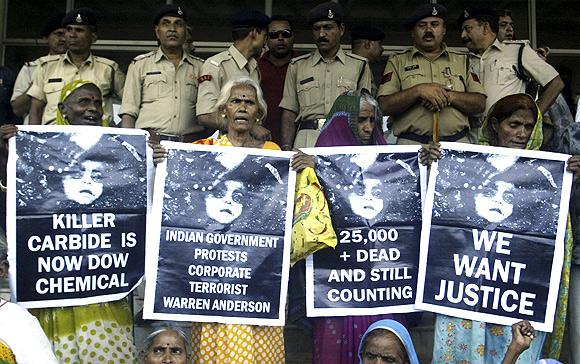
You may have noticed that the woman in the middle of that last picture, which appears to have been taken no later than 2007, is holding a sign equating Osama bin Laden to Anderson. Why is the anger and bitterness still so fresh, after all these years?
Probably because people are still being poisoned.
Fifteen years before the disaster, the people at that plant were burying literal tons of their nasty chemical byproducts in the ground around the plant or dumping it in "evaporation pools" that overflowed with every heavy rain, contaminating the soil and groundwater for miles around and causing painful birth defects and horrifically high child mortality rates.
And Dow Chemical (which now owns Union Carbide) doesn't seem to be doing a damn thing about it. Except for spying on activists who have advocated for the victims of the Bhopal disaster, which seems like a rather special level of sliminess and makes me glad that corporate personhood is just an annoying set of legal loopholes instead of a literal thing. I would not want someone as careless, callous and underhanded as that as a neighbor.
Unfortunately for the people of Bhopal, though, they had no choice in the matter.
Showing posts with label 1980's History Trivia. Show all posts
Wednesday, December 3, 2014
Wednesday, November 26, 2014
On This Day In 1983...
Six robbers broke into the Brink's-MAT warehouse at Heathrow Airport, looking to steal some cash. These robbers were, apparently, quite a well-organized and ruthless lot; they posed as security guards to get into the warehouse and, once in, doused one of the legitimate guards in gasoline and threatened to set him on fire if he didn't give them the combination to the vault. The vault turned out not to be stuffed with cash as they had expected, but with gold ingots, so they had to settle for making off with 6,800 of these instead--about £26 million worth of gold in 1983 currency.
(My mathematically minded husband points out* that, assuming no non-gold stolen goods like gems or cash are included in the £26 million figure and assuming he got the historical exchange rates right, that's enough gold to fill approximately 40.29 1-gallon milk jugs, and each of those jugs would weigh about 140 pounds. That's a lot of heavy gold to haul out to your getaway car. I hope for their sake that they brought a dolly or a wagon or something.)
Unfortunately for the robbers, they were just a little too well-organized for their own good. The police couldn't help but notice that they had seemed to possess inside knowledge of the warehouse's security procedures, and they started questioning Anthony Black, a guard who worked at the warehouse. This led to the arrest and conviction of two of the robbers--one of whom was Black's brother-in-law.
The stolen gold was never fully recovered. Kenneth Noye was caught fencing some of it in 1985 and eleven complete bars were found in his house (he'd attempted to launder the rest of it by melting it and mixing it with copper coins) and police in Austria confiscated ten bars from some suspects they had arrested at a hotel in Vienna--but the bars turned out to be counterfeits made of gold-coated tungsten, which the arrested suspects (who had nothing to do with the original robbery) planned to sell as genuine artifacts from the Heathrow robbery.
By the way, if you're thinking, "Wow, this is such a dramatic story, I wonder why no one's made it into a movie yet?" right about now, you should know that someone totally has. It was made for TV and only has a 6.5 out of 10 rating on IMDb, but it has Sean Bean in it. And if all robbers looked like Sean Bean, I would keep my front door unlocked and covered in signs that read "FREE DIAMONDS!"
*If you'd like to check his math, here are the resources he used:
http://www.nma.org/pdf/gold/his_gold_prices.pdf
http://www.measuringworth.com/exchangepound/
http://taxfreegold.co.uk/goldbardimensions.html
Wednesday, November 19, 2014
On This Day In 1980...
A Calvin Klein ad featuring a teenage Brooke Shields and a racy double entendre got banned from the air for being too risque.
So...yeah. It's basically a joke about going commando. Honestly, though, that position she's in disturbs me more than the naughty underwear-related one-liner. That looks really, really uncomfortable. It looks even more uncomfortable when you realize that she's just sort of...sitting there and holding that pose. Like a creepy doll. I look at it and can't help but think of that artist who got random women to imitate weird, unnatural fashion model poses in real life and secretly filmed the reactions of people passing by.
I like this other 1980s Calvin Klein ad featuring Brooke Shields better. Some of those weird poses are still there, but at least she gets to move around and give a smart-person speech. Also, I'm a sucker for a good pun. (Kinda wish she'd kept the glasses on, though.)
So...yeah. It's basically a joke about going commando. Honestly, though, that position she's in disturbs me more than the naughty underwear-related one-liner. That looks really, really uncomfortable. It looks even more uncomfortable when you realize that she's just sort of...sitting there and holding that pose. Like a creepy doll. I look at it and can't help but think of that artist who got random women to imitate weird, unnatural fashion model poses in real life and secretly filmed the reactions of people passing by.
I like this other 1980s Calvin Klein ad featuring Brooke Shields better. Some of those weird poses are still there, but at least she gets to move around and give a smart-person speech. Also, I'm a sucker for a good pun. (Kinda wish she'd kept the glasses on, though.)
Wednesday, October 15, 2014
On This Day In 1984...
...this is what TIME Magazine's cover art looked like:
I love that the stereotypical fedora-wearing mobster on the left looks startled and awkwardly frozen in place, like he just realized that everyone is looking at him and doesn't know what to do about it, while the other one is all, like, "Pssh! Shine your stupid giant flashlights on me all you want--ain't no heavy-handed metaphor for increased scrutiny gonna stop me from pointing my comically tiny gun at no one in particular!"
If you subscribe to TIME, you can read this issue's full cover story here. I don't happen to be a subscriber, but the first few sentences of the article are visible to all, and they make the article look like a pretty gripping read.
They'd also make a good prompt for one of those writing exercises they make you do in creative writing courses:
"It was a moonless night in the Sicilian city of Palermo, a night filled with the sirocco, a torrid, noisy wind that blows in across the Mediterranean from the Sahara, moaning through the city's narrow streets and driving its inhabitants indoors. Few if any residents noticed as squads of armored cars raced through the streets and gun-toting officers cordoned off the city into three sections."
Actually, a lot of first few sentences of TIME articles would make good writing prompts. Here are a few good ones I found while poking around their archives:
"The tiger hunter of yore was a maharajah or British aristocrat who would take potshots at roaring beasts while perched atop an elephant." -A Shotgun, a Promise of $5 and a Skinned Cat, March 28, 1994
"Signs in the store windows of Brook, Ind. (pop. 888) said simply: "Gone to the Funeral." No one had to ask whose." -Home is the Hoosier, May 29, 1944
"Through the mud of Fox Island in Puget Sound clumps a stubby and sturdy woman wearing a vibrant green baseball cap, a gold and green sweatsuit, and a T shirt emblazoned SAVE OUR FISHING FLEET." -Dixy Rocks the Northwest, Monday, December 12, 1977
"It lasted only 15 minutes, but Isabel and Joseph Garrett will undoubtedly remember it as the best TV program of their lives." -The Family: Electronic Adoption, Friday, May 31, 1968
So now I know what I'll do if I ever get called on to teach a fiction writing class. Pick one of the above, kids. Run with it. I want to see 1,000 words from you, due on Friday. Make it horror, fantasy, thriller, mystery, any genre you want, but don't you dare have it all turn out to be a dream in the end. That is lazy writing, and I will not hesitate to fail your ass.*
*This is why I have not been called on to teach a fiction writing class.
I love that the stereotypical fedora-wearing mobster on the left looks startled and awkwardly frozen in place, like he just realized that everyone is looking at him and doesn't know what to do about it, while the other one is all, like, "Pssh! Shine your stupid giant flashlights on me all you want--ain't no heavy-handed metaphor for increased scrutiny gonna stop me from pointing my comically tiny gun at no one in particular!"
If you subscribe to TIME, you can read this issue's full cover story here. I don't happen to be a subscriber, but the first few sentences of the article are visible to all, and they make the article look like a pretty gripping read.
They'd also make a good prompt for one of those writing exercises they make you do in creative writing courses:
"It was a moonless night in the Sicilian city of Palermo, a night filled with the sirocco, a torrid, noisy wind that blows in across the Mediterranean from the Sahara, moaning through the city's narrow streets and driving its inhabitants indoors. Few if any residents noticed as squads of armored cars raced through the streets and gun-toting officers cordoned off the city into three sections."
Actually, a lot of first few sentences of TIME articles would make good writing prompts. Here are a few good ones I found while poking around their archives:
"The tiger hunter of yore was a maharajah or British aristocrat who would take potshots at roaring beasts while perched atop an elephant." -A Shotgun, a Promise of $5 and a Skinned Cat, March 28, 1994
"Signs in the store windows of Brook, Ind. (pop. 888) said simply: "Gone to the Funeral." No one had to ask whose." -Home is the Hoosier, May 29, 1944
"Through the mud of Fox Island in Puget Sound clumps a stubby and sturdy woman wearing a vibrant green baseball cap, a gold and green sweatsuit, and a T shirt emblazoned SAVE OUR FISHING FLEET." -Dixy Rocks the Northwest, Monday, December 12, 1977
"It lasted only 15 minutes, but Isabel and Joseph Garrett will undoubtedly remember it as the best TV program of their lives." -The Family: Electronic Adoption, Friday, May 31, 1968
So now I know what I'll do if I ever get called on to teach a fiction writing class. Pick one of the above, kids. Run with it. I want to see 1,000 words from you, due on Friday. Make it horror, fantasy, thriller, mystery, any genre you want, but don't you dare have it all turn out to be a dream in the end. That is lazy writing, and I will not hesitate to fail your ass.*
*This is why I have not been called on to teach a fiction writing class.
Wednesday, October 8, 2014
On This Day In 1985...
...Leon Klinghoffer was murdered by terrorists.
Mr. Klinghoffer was unfortunate enough to be a passenger on an Italian cruise ship, the Achille Lauro, which was hijacked by four members of the Palestinian Liberation Front off the coast of Egypt. The hijackers had two demands: They wanted 50 prisoners released from various Israeli prisons (including Lebanon'sfavorite common thug "national hero" Samir Kuntar), and they wanted the captain to sail the ship to Syria.
Unfortunately for the hijackers, their plan went pear-shaped pretty fast. Syrian officials refused to let them dock the ship, and it didn't look like any prisoner releases were forthcoming from Israel either. Angered by their failure, the hijackers searched for some way to vent their anger and eventually settled--pretty much at random, from what I can tell--on punishing Leon Klinghoffer for the unforgivable crime of being Jewish and alive.
They shot him dead and forced two members of the ship's crew to throw him and his wheelchair--that's right; his wheelchair--overboard. Then they fed his wife, who didn't witness the shooting, a line of bullshit about him having been taken to the ship's infirmary to recover from some mystery illness. She didn't find out the truth until she'd gotten off the boat.
So.
Let's talk about terrorists and their obsession with martyrdom.
Extremists--be they politically motivated, religiously motivated, or some unholy combination of the two--just love them some fantasizing about dying gloriously for the cause, preferably after killing lots and lots of those evil, oppressing infidels.
In their zeal and shortsightedness, however, they forget that the "other side" can make martyrs out of their dead too.
Still, you'd think that even the most worthless, mentally stunted dumbfuck of a terrorist (and they do have a hilariously high percentage of worthless, mentally stunted dumbfucks in their ranks) would be just a little smarter about picking a victim. I mean, really. A whole boat full of passengers, and the one guy they singled out for brutal murder was a disabled senior citizen who looked like everyone's sweet old grandpa?
Did they honestly not see the gigantic, public-relations-disaster-shaped flaw in this plan?
Of course they didn't. Hatred does weird things to people. It makes them impulsive and thoughtless. It makes them stupid.
And honestly, if you're the kind of person in the first place who would look at some random ship full of tourists and somehow make the mental leap to "I bet I could use that thing to get my buddies out of prison if I'm a big enough asshat!" then you probably stand even less of a chance against the brain rot.
As for the hijackers themselves, they accepted an offer of safe passage to Tunisia in exchange for leaving the ship. That didn't turn out very well for them. And in 1996, Muhammad Zaidan (AKA Abu Abbas), the mastermind of the Achille Lauro hijacking, tried to kind-of sort-of apologize for the murder. The Klinghoffer family was not impressed. Props to them for not straight-up telling the guy to drop dead. I'm not sure I would have shown such restraint in their place.
Mr. Klinghoffer was unfortunate enough to be a passenger on an Italian cruise ship, the Achille Lauro, which was hijacked by four members of the Palestinian Liberation Front off the coast of Egypt. The hijackers had two demands: They wanted 50 prisoners released from various Israeli prisons (including Lebanon's
Unfortunately for the hijackers, their plan went pear-shaped pretty fast. Syrian officials refused to let them dock the ship, and it didn't look like any prisoner releases were forthcoming from Israel either. Angered by their failure, the hijackers searched for some way to vent their anger and eventually settled--pretty much at random, from what I can tell--on punishing Leon Klinghoffer for the unforgivable crime of being Jewish and alive.
They shot him dead and forced two members of the ship's crew to throw him and his wheelchair--that's right; his wheelchair--overboard. Then they fed his wife, who didn't witness the shooting, a line of bullshit about him having been taken to the ship's infirmary to recover from some mystery illness. She didn't find out the truth until she'd gotten off the boat.
So.
Let's talk about terrorists and their obsession with martyrdom.
Extremists--be they politically motivated, religiously motivated, or some unholy combination of the two--just love them some fantasizing about dying gloriously for the cause, preferably after killing lots and lots of those evil, oppressing infidels.
In their zeal and shortsightedness, however, they forget that the "other side" can make martyrs out of their dead too.
Still, you'd think that even the most worthless, mentally stunted dumbfuck of a terrorist (and they do have a hilariously high percentage of worthless, mentally stunted dumbfucks in their ranks) would be just a little smarter about picking a victim. I mean, really. A whole boat full of passengers, and the one guy they singled out for brutal murder was a disabled senior citizen who looked like everyone's sweet old grandpa?
Did they honestly not see the gigantic, public-relations-disaster-shaped flaw in this plan?
Of course they didn't. Hatred does weird things to people. It makes them impulsive and thoughtless. It makes them stupid.
And honestly, if you're the kind of person in the first place who would look at some random ship full of tourists and somehow make the mental leap to "I bet I could use that thing to get my buddies out of prison if I'm a big enough asshat!" then you probably stand even less of a chance against the brain rot.
As for the hijackers themselves, they accepted an offer of safe passage to Tunisia in exchange for leaving the ship. That didn't turn out very well for them. And in 1996, Muhammad Zaidan (AKA Abu Abbas), the mastermind of the Achille Lauro hijacking, tried to kind-of sort-of apologize for the murder. The Klinghoffer family was not impressed. Props to them for not straight-up telling the guy to drop dead. I'm not sure I would have shown such restraint in their place.
Wednesday, October 1, 2014
On This Day In 1987...
...a 5.9 magnitude earthquake rocked the San Gabriel Valley.
The Whittier Narrows earthquake, as it came to be known, wasn't the biggest earthquake in California history; it doesn't crack the top seven, or even the top fifty. But it still did some pretty dramatic damage:
Since this was an earthquake rather than a hurricane, those who lived through it had to deal with problems like gas and water main breaks on top of the above-ground destruction. Also, it trapped office workers in elevators, crushed people under concrete, and threw them out of windows. At least three of the people who died in the quake were killed by heart attacks. As in, they were literally scared to death. And that was a relatively moderate earthquake.
I'll end this post by noting that Whittier, the town most affected by the quake, was apparently "best known as the boyhood home of Richard M. Nixon" at the time. Take from that what you will.
The Whittier Narrows earthquake, as it came to be known, wasn't the biggest earthquake in California history; it doesn't crack the top seven, or even the top fifty. But it still did some pretty dramatic damage:
Since this was an earthquake rather than a hurricane, those who lived through it had to deal with problems like gas and water main breaks on top of the above-ground destruction. Also, it trapped office workers in elevators, crushed people under concrete, and threw them out of windows. At least three of the people who died in the quake were killed by heart attacks. As in, they were literally scared to death. And that was a relatively moderate earthquake.
I'll end this post by noting that Whittier, the town most affected by the quake, was apparently "best known as the boyhood home of Richard M. Nixon" at the time. Take from that what you will.
Wednesday, September 24, 2014
On This Day In 1986...
So.
Since we're already on the subject of religion from Monday's post, I'd like to share this archived New York Times article I found.
The gist of the article is that the Vatican, in an attempt to preserve religious orthodoxy, randomly punished a bunch of local church leaders who didn't conform perfectly to established Catholic doctrine. For instance, the article mentions one Archbishop Hunthausen who was stripped of most of his authority after the Vatican started suspecting him of "tolerating liberal practices in marriage annulment, liturgy and other spheres."
Not believing in or practicing, you'll notice. Just tolerating. Stay classy, 80's Vatican.
Fortunately, someone was willing to speak out against this madness. Rembert G. Weakland, Archbishop of Milwaukee and owner of one of the most incredibly Dickensian names I've ever encountered, wrote some columns criticizing the Vatican's methods. This was the first time someone so relatively high in the Church hierarchy had ever openly spoken out against the Vatican's methods, so this was a fairly big deal.
He was pretty sassy, too. He accused the Church of "fanaticism and small-mindedness" and claimed that their practice of "theological suppression" had caused "a total lack of theological creativity in the U.S.A. for half a century." BURN.
Then the story took a dark turn.
I looked up this Archbishop Weakland on Wikipedia to learn more about him.
Turns out he's a bit of a shithead. Of the protecting pedophile priests and intimidating child victims of sexual abuse into not coming forward kind. The kind who told children reporting sexual abuse that they were "squealing."
Damn. Now I'm not rooting for anyone in this story except good ol' liberal-theology-tolerating Archbishop Hunthausen. But I'm not looking him up on Wikipedia. With my luck, I'll probably find out that he habitually drop-kicked baby bunnies or fed orphans to tigers or something, and I don't want to know.
Since we're already on the subject of religion from Monday's post, I'd like to share this archived New York Times article I found.
The gist of the article is that the Vatican, in an attempt to preserve religious orthodoxy, randomly punished a bunch of local church leaders who didn't conform perfectly to established Catholic doctrine. For instance, the article mentions one Archbishop Hunthausen who was stripped of most of his authority after the Vatican started suspecting him of "tolerating liberal practices in marriage annulment, liturgy and other spheres."
Not believing in or practicing, you'll notice. Just tolerating. Stay classy, 80's Vatican.
Fortunately, someone was willing to speak out against this madness. Rembert G. Weakland, Archbishop of Milwaukee and owner of one of the most incredibly Dickensian names I've ever encountered, wrote some columns criticizing the Vatican's methods. This was the first time someone so relatively high in the Church hierarchy had ever openly spoken out against the Vatican's methods, so this was a fairly big deal.
He was pretty sassy, too. He accused the Church of "fanaticism and small-mindedness" and claimed that their practice of "theological suppression" had caused "a total lack of theological creativity in the U.S.A. for half a century." BURN.
Then the story took a dark turn.
I looked up this Archbishop Weakland on Wikipedia to learn more about him.
Turns out he's a bit of a shithead. Of the protecting pedophile priests and intimidating child victims of sexual abuse into not coming forward kind. The kind who told children reporting sexual abuse that they were "squealing."
Damn. Now I'm not rooting for anyone in this story except good ol' liberal-theology-tolerating Archbishop Hunthausen. But I'm not looking him up on Wikipedia. With my luck, I'll probably find out that he habitually drop-kicked baby bunnies or fed orphans to tigers or something, and I don't want to know.
Wednesday, September 17, 2014
On This Day In 1989...
...Hurricane Hugo made its first landfall on St. Croix--the first stop in a destructive path over the mid-Atlantic cost of the United States. Hugo was a pretty big hurricane:
And like most big hurricanes, it was capable of wrecking a whole lotta buildings (especially beautiful historical buildings like St. Luke's Chapel in Charleston, because hurricanes are assholes):
And putting boats where boats don't belong:
I don't know whose beached sailing vessel that is in the above photo, but the fact that it's named Guppy seems creepily apt, given how utterly small and insignificant it clearly was before the storm's might. Also, because I'm a bad person sometimes, I couldn't help but imagine that it flopped around in the roadway and gasped for breath like a giant guppy after it was deposited there.
Hugo was a pretty expensive hurricane. Once it finished ripping through the US, it had done about 7 billion dollars' worth of damage. That made it the most expensive hurricane the United States had ever seen at the time. Here's a post-hurricane picture from (I think) Charlotte, North Carolina that emphasizes the extent of the infrastructure damage Hugo caused:
And because talking about the tragic aftermath of a terrible, destructive storm is awfully sad-making, I'll end this post with a completely irrelevant story.
When my husband and I were living in Connecticut, we were on a main road with the big, heavy-duty power cables that piped in the town's main electricity supply running along it. Those cables were mounted on utility poles similar to the ones in the picture above, but a bit taller and with more branching bits at the top to carry more wires. Those poles ran along the other side of the street from our house, but there was one pole--a bit shorter than the main ones, but just as thick and no less sturdily fixed in the ground--on the edge of our lawn. This pole held the wires that carried power to our house and the neighbor's house.
Late one night some (probably) drunk idiot plowed a car into "our" pole. Hard. I woke up to find the power out; about seven police cars clogging the road in front of the house; and on our lawn, a small-ish sedan that was going to need some extensive body work before it got back on the road, because the utility pole that used to be vertical and in the ground by the side of the road was now perfectly horizontal--and very much not in the ground--right across the mystery car's crushed-in roof.
The utility poles in the photo above made me think of that incident. Despite being recently battered by the winds of a class 5 hurricane, even though they're obviously damaged and the cables on them almost certainly aren't functioning, they're still standing. Our pole, though? Let one stupid human come along in some crappy little car, and it gets taken right to the pavement.
There's a deep, insightful metaphor in there somewhere. Or possibly a lesson about the distribution of force.
And like most big hurricanes, it was capable of wrecking a whole lotta buildings (especially beautiful historical buildings like St. Luke's Chapel in Charleston, because hurricanes are assholes):
And putting boats where boats don't belong:
I don't know whose beached sailing vessel that is in the above photo, but the fact that it's named Guppy seems creepily apt, given how utterly small and insignificant it clearly was before the storm's might. Also, because I'm a bad person sometimes, I couldn't help but imagine that it flopped around in the roadway and gasped for breath like a giant guppy after it was deposited there.
Hugo was a pretty expensive hurricane. Once it finished ripping through the US, it had done about 7 billion dollars' worth of damage. That made it the most expensive hurricane the United States had ever seen at the time. Here's a post-hurricane picture from (I think) Charlotte, North Carolina that emphasizes the extent of the infrastructure damage Hugo caused:
And because talking about the tragic aftermath of a terrible, destructive storm is awfully sad-making, I'll end this post with a completely irrelevant story.
When my husband and I were living in Connecticut, we were on a main road with the big, heavy-duty power cables that piped in the town's main electricity supply running along it. Those cables were mounted on utility poles similar to the ones in the picture above, but a bit taller and with more branching bits at the top to carry more wires. Those poles ran along the other side of the street from our house, but there was one pole--a bit shorter than the main ones, but just as thick and no less sturdily fixed in the ground--on the edge of our lawn. This pole held the wires that carried power to our house and the neighbor's house.
Late one night some (probably) drunk idiot plowed a car into "our" pole. Hard. I woke up to find the power out; about seven police cars clogging the road in front of the house; and on our lawn, a small-ish sedan that was going to need some extensive body work before it got back on the road, because the utility pole that used to be vertical and in the ground by the side of the road was now perfectly horizontal--and very much not in the ground--right across the mystery car's crushed-in roof.
The utility poles in the photo above made me think of that incident. Despite being recently battered by the winds of a class 5 hurricane, even though they're obviously damaged and the cables on them almost certainly aren't functioning, they're still standing. Our pole, though? Let one stupid human come along in some crappy little car, and it gets taken right to the pavement.
There's a deep, insightful metaphor in there somewhere. Or possibly a lesson about the distribution of force.
Wednesday, September 3, 2014
On This Day In 1984...
...South Africa adopted a new constitution. This constitution expanded the South African parliament to be more inclusive, adding a House of Representatives to represent the country's Coloured (mixed race) population and a House of Delegates to represent Indians. Yay South Africa!
Of course, they somehow didn't get around to giving Blacks the right to vote until 1994. But hey, at least they only took ten years to do it. Considering the fact that it took the USA 93 years to extend constitutional voting rights to African Americans and about a hundred years longer to convince (most) white Americans that not letting African Americans vote is a crappy thing to do, I think the South African government actually did a pretty good job.
Wednesday, August 27, 2014
On This Day In 1981...
...deep sea divers recovered a safe from the wreck of the SS Andrea Doria, which sank in 1965 after a collision with another ship.
The expedition was financed by one Peter Gimbel, who planned to open the safe on a live TV broadcast. Unfortunately the safe turned out not to contain any shiny, photogenic jewelry, but it was stuffed with travellers checks and various Italian, Canadian, and US bank notes, which Gimbel fixed up and sold as souvenirs. Most of the notes obviously aren't in the best of shape, but they make pretty neat-looking decorations all the same.
Side note: I think shipwrecks are woefully underused as creepy settings in movies and books. Imagine diving down, down, down into the murky, silent waters and suddenly seeing this gutted, corpse-like monstrosity right under you:
Oh, and did I mention that according to Wikipedia, divers call the Andrea Doria a "noisy" wreck, because it sank in just the right place that the currents are slowly tearing it apart and constantly scraping metal on metal? The article doesn't go into detail about what that sounds like, but in my imagination it sounds like the forsaken otherworldly wailing of a million tortured souls imprisoned in the cold embrace of Davey Jones' locker. Oh, and sixteen divers have died exploring the thing, so it's probably legit haunted.
Don't get me wrong--I'd totally finance an expedition like that if I had the means. Salvaged stuff is pretty cool to look at, as long as it's in a museum on good ol' dry land. If I had to go down there myself, though? I'd have to really, really, really want whatever was in that safe.
The expedition was financed by one Peter Gimbel, who planned to open the safe on a live TV broadcast. Unfortunately the safe turned out not to contain any shiny, photogenic jewelry, but it was stuffed with travellers checks and various Italian, Canadian, and US bank notes, which Gimbel fixed up and sold as souvenirs. Most of the notes obviously aren't in the best of shape, but they make pretty neat-looking decorations all the same.
Side note: I think shipwrecks are woefully underused as creepy settings in movies and books. Imagine diving down, down, down into the murky, silent waters and suddenly seeing this gutted, corpse-like monstrosity right under you:
Oh, and did I mention that according to Wikipedia, divers call the Andrea Doria a "noisy" wreck, because it sank in just the right place that the currents are slowly tearing it apart and constantly scraping metal on metal? The article doesn't go into detail about what that sounds like, but in my imagination it sounds like the forsaken otherworldly wailing of a million tortured souls imprisoned in the cold embrace of Davey Jones' locker. Oh, and sixteen divers have died exploring the thing, so it's probably legit haunted.
Don't get me wrong--I'd totally finance an expedition like that if I had the means. Salvaged stuff is pretty cool to look at, as long as it's in a museum on good ol' dry land. If I had to go down there myself, though? I'd have to really, really, really want whatever was in that safe.
Wednesday, August 20, 2014
On This Day In 1985...
So I found this article in the New York Times archive.
The gist of the article is that the United States was considering imposing economic sanctions on the South African government for being horrible and oppressive, and one Reverend Jerry Falwell really didn't want that to happen.
Don't get me wrong. I'm not saying that no one should ever oppose economic sanctions because--let's face it--economic sanctions kind of suck as a way to make brutal dictators stop being brutal, and usually end up doing more harm to the oppressed people they're meant to help. But even if he was concerned about this possibility, Jerry Falwell was physically incapable of not coming across as a terrible person.
His argument was basically that he talked to South Africans "in every segment of every community"* and they didn't like the idea of sanctions, so obviously everyone is fine with the way things are and we should keep on supporting the (horrible) Pretoria Government and investing in companies that do business in South Africa.
He also didn't like anyone who brought an opposing viewpoint to the table, most notably Bishop Desmond Tutu, about whom he said, "If Bishop Tutu maintains that he speaks for the black people of South Africa, he's a phony."
Hmm.
Bishop Tutu...
or Jerry Falwell?
One of these guys looks waaaaay more qualified to "speak for the black people of South Africa" than the other.
Here's a hint: It's not the rich white American guy.
*This is probably a teensy exaggeration on his part. Somehow I just can't see the Reverend Falwell, in his immaculate suit and silk tie and his perfectly slicked-back 80's-businessman hair, trudging around the poorest slums in Johannesburg to fulfill his "every segment of every community" requirement.
The gist of the article is that the United States was considering imposing economic sanctions on the South African government for being horrible and oppressive, and one Reverend Jerry Falwell really didn't want that to happen.
Don't get me wrong. I'm not saying that no one should ever oppose economic sanctions because--let's face it--economic sanctions kind of suck as a way to make brutal dictators stop being brutal, and usually end up doing more harm to the oppressed people they're meant to help. But even if he was concerned about this possibility, Jerry Falwell was physically incapable of not coming across as a terrible person.
His argument was basically that he talked to South Africans "in every segment of every community"* and they didn't like the idea of sanctions, so obviously everyone is fine with the way things are and we should keep on supporting the (horrible) Pretoria Government and investing in companies that do business in South Africa.
He also didn't like anyone who brought an opposing viewpoint to the table, most notably Bishop Desmond Tutu, about whom he said, "If Bishop Tutu maintains that he speaks for the black people of South Africa, he's a phony."
Hmm.
Bishop Tutu...
or Jerry Falwell?
One of these guys looks waaaaay more qualified to "speak for the black people of South Africa" than the other.
Here's a hint: It's not the rich white American guy.
*This is probably a teensy exaggeration on his part. Somehow I just can't see the Reverend Falwell, in his immaculate suit and silk tie and his perfectly slicked-back 80's-businessman hair, trudging around the poorest slums in Johannesburg to fulfill his "every segment of every community" requirement.
Wednesday, July 30, 2014
Stuff That Happened in the 80's: Sistine Chapel Restoration
In June of 1980, a restoration team started scrubbing approximately five hundred years of candle smoke residue off the ceiling of the Sistine Chapel, revealing Michelangelo's famous frescoes as he (theoretically, anyway) originally painted them. The restoration process took up two whole decades--the wall frescoes, the last part of the chapel to be restored, were officially unveiled in 1999--and the results are pretty dramatic:
There had been previous attempts to restore the Sistine Chapel, but none this ambitious. By the way, did you know that art restorers in the 1600's cleaned unwanted mineral deposits off frescoes by rubbing them with bread? I sure didn't.
This modern restoration was also noteworthy because there were people who hated the crap out of it. Andrew Wordsworth, a reporter for a London-based newspaper called The Independent, complained that the restored artwork "has a curiously washed-out look, with pretty but flavourless coloring--an effect quite unlike that of Michelangelo's intensely sensual sculpture." My giant, paving-stone-like vintage copy of Chronicle of the 20th Century tells me that one particularly offended critic "compared the project to a nuclear disaster," thus proving that hyperbolic nerd rage is not unique to the internet generation.
There had been previous attempts to restore the Sistine Chapel, but none this ambitious. By the way, did you know that art restorers in the 1600's cleaned unwanted mineral deposits off frescoes by rubbing them with bread? I sure didn't.
This modern restoration was also noteworthy because there were people who hated the crap out of it. Andrew Wordsworth, a reporter for a London-based newspaper called The Independent, complained that the restored artwork "has a curiously washed-out look, with pretty but flavourless coloring--an effect quite unlike that of Michelangelo's intensely sensual sculpture." My giant, paving-stone-like vintage copy of Chronicle of the 20th Century tells me that one particularly offended critic "compared the project to a nuclear disaster," thus proving that hyperbolic nerd rage is not unique to the internet generation.
Wednesday, July 23, 2014
On This Day In 1987...
...Hulda Crooks became the oldest woman to climb to the top of Mt. Fuji. She was 91 years old at the time.
91. Years. Old.
Oh, and Wikipedia informs me that Crooks got her endearing nickname, Grandma Whitney, by scaling 14,505-foot Mt. Whitney a couple times between her 65th and 91st birthdays. And by a couple times, I mean 23 freaking times. At a time in life when most people start using the handicapped ramp at the local library because they just can't maneuver their walkers up those three stairs very well. Way to make me feel dismally inadequate for finding yet another excuse not to get on the elliptical today, Grandma Whitney.
You know, I've always wondered why the Japanese have that old saying: "He who has not climbed Mt. Fuji is a fool. He who climbs it twice is a bigger fool--unless they're Hulda Crooks. She's just up there because she had some time to kill before her lunch reservation."
Wednesday, July 16, 2014
On This Day In 1982...
...the Reverend Sun Myung Moon performed 2,075 weddings.
No, it wasn't part of the plot of some wacky 80's sitcom about a forgetful minister who makes 2,075 madcap, zany-accident-laden dashes between multiple churches in an attempt to perform all the weddings he's been booked for that day, eventually learning a Very Important Lesson about how trying to please everyone just leaves everyone unhappy. The Rev. Moon was the founder and head of the Unification Church, which holds enormous mass weddings called "marriage re-dedication ceremonies." This particular ceremony was held in Madison Square Garden, and most of the couples involved were personally matched up--only a few weeks beforehand, in some cases--by the Rev. Moon himself.
Okay, that sounds kind of creepy and cult-like, and I'd definitely run a million miles from anyone who asked me to marry some dude I met two weeks ago in a communal wedding with 2,074 other couples for Jesus. But the American Psychological Association (eventually) decided that they probably don't brainwash their members, so there's that. Besides, here's a picture of the Rev. Moon...
...and I just can't stay mad at a guy who looks like he just left the house to run a quick errand--and completely forgot that he never took off the sparkly dress-up clothes he was playing tea party with his granddaughters in.
No, it wasn't part of the plot of some wacky 80's sitcom about a forgetful minister who makes 2,075 madcap, zany-accident-laden dashes between multiple churches in an attempt to perform all the weddings he's been booked for that day, eventually learning a Very Important Lesson about how trying to please everyone just leaves everyone unhappy. The Rev. Moon was the founder and head of the Unification Church, which holds enormous mass weddings called "marriage re-dedication ceremonies." This particular ceremony was held in Madison Square Garden, and most of the couples involved were personally matched up--only a few weeks beforehand, in some cases--by the Rev. Moon himself.
Okay, that sounds kind of creepy and cult-like, and I'd definitely run a million miles from anyone who asked me to marry some dude I met two weeks ago in a communal wedding with 2,074 other couples for Jesus. But the American Psychological Association (eventually) decided that they probably don't brainwash their members, so there's that. Besides, here's a picture of the Rev. Moon...
...and I just can't stay mad at a guy who looks like he just left the house to run a quick errand--and completely forgot that he never took off the sparkly dress-up clothes he was playing tea party with his granddaughters in.
Wednesday, July 9, 2014
On This Day In 1982...
Pan Am Flight 759 crashed.
No, not that Pan Am flight. Or that one.* This particular plane was bound for San Diego when it got caught in a microburst and went down just a few minutes after taking off from New Orleans International Airport. All 145 passengers and crew on board were killed, and eight people on the ground died as well. 32 years have elapsed since the crash, but the Pan Am Flight 759 disaster still holds the dubious honor of being the fifth deadliest aviation disaster to occur on US soil.
By the way, check out this weirdly unsettling illustration of a microburst. Seriously, has anything ever looked more like the ravening proboscis of a rampaging insectoid wind god?
*Note to self: If trapped in the 1980's, don't fly Pan Am.
No, not that Pan Am flight. Or that one.* This particular plane was bound for San Diego when it got caught in a microburst and went down just a few minutes after taking off from New Orleans International Airport. All 145 passengers and crew on board were killed, and eight people on the ground died as well. 32 years have elapsed since the crash, but the Pan Am Flight 759 disaster still holds the dubious honor of being the fifth deadliest aviation disaster to occur on US soil.
By the way, check out this weirdly unsettling illustration of a microburst. Seriously, has anything ever looked more like the ravening proboscis of a rampaging insectoid wind god?
*Note to self: If trapped in the 1980's, don't fly Pan Am.
Wednesday, July 2, 2014
On This Day In 1986...
A massive nationwide strike started in Chile to protest the Pinochet regime. General Pinochet reacted to the strike like only a tin-pot dictator butthurt that everyone doesn't love him can: by having protesters peppered with bullets and tear gas. Also possibly having some people set on fire.
By the way, Pinochet conveniently died of a heart attack in 2006 before he could be properly convicted of any human rights abuses. Feh.
Wednesday, June 25, 2014
On This Day In 1986...
Congress voted to give aid to the Nicaraguan rebel group known as the Contras. 100 million dollars' worth. Fortunately it was just a one-time payment, and no one, like, sold a bunch of weapons to Iran for the money to keep on funding...Oh, crap.
Wednesday, June 18, 2014
On This Day In 1983...
Sally Ride becomes the first U.S. woman to go into space!
Where, according to Wikipedia, she also became the first woman to operate the space shuttle Challenger's robotic arm, using it to retrieve a satellite. So basically she got to play a super-epic scaled-up version of that stuffed animal claw game from the carnival in space. And got paid for doing so. No wonder every kid wants to be an astronaut.
Also, reporters at the time apparently saw nothing wrong with asking her dumbass questions like, "Will the flight affect your reproductive organs?"
Really, reporters? REALLY? You meet the first woman in the country to have a career piloting awesome space-robots, and all you can think to say to her is that idiotic string of words? You might as well have said, "Durr hurr hurr, yer a gurl! In space! Gurl in space funny! Durr hurr."
So here's to you, Sally Ride. You broke barriers, and you never once* punched out a stupid-question-asking 1980's reporter.
*That I know of, anyway.
Where, according to Wikipedia, she also became the first woman to operate the space shuttle Challenger's robotic arm, using it to retrieve a satellite. So basically she got to play a super-epic scaled-up version of that stuffed animal claw game from the carnival in space. And got paid for doing so. No wonder every kid wants to be an astronaut.
Also, reporters at the time apparently saw nothing wrong with asking her dumbass questions like, "Will the flight affect your reproductive organs?"
Really, reporters? REALLY? You meet the first woman in the country to have a career piloting awesome space-robots, and all you can think to say to her is that idiotic string of words? You might as well have said, "Durr hurr hurr, yer a gurl! In space! Gurl in space funny! Durr hurr."
So here's to you, Sally Ride. You broke barriers, and you never once* punched out a stupid-question-asking 1980's reporter.
*That I know of, anyway.
Subscribe to:
Posts (Atom)